The ADA Guide to Commercial Mat Rentals
Creating an accessible and welcoming environment for all visitors means commercial facilities must pay careful attention to every detail—including their floor matting systems. Rental mats can enhance the accessibility of facilities if they meet the proper requirements, they are properly placed, and they are maintained on a regular basis.
To assist in that endeavor, the Americans with Disabilities Act (ADA) establishes comprehensive guidelines that include specific requirements for flooring elements, including commercial mats. Maintaining compliance while providing a safe, accessible environment for employees, customers, and visitors with disabilities comes down to understanding these requirements and integrating them into your facility design and mat program.
Navigating ADA compliance for commercial matting doesn’t have to be complicated. We’ve outlined the relevant standards and how Health Mats commercial mat rentals comply with ADA guidelines.
ADA Standards

When it comes to the ADA standards for floor mats, there is one primary goal – eliminate barriers and minimize hazards for individuals with disabilities, particularly those using mobility aids such as wheelchairs, walkers, or canes. Since these requirements apply to any mat located on an accessible route or circulation path within commercial facilities, all matting at business entrances and high-traffic areas should meet these requirements.
What Makes a Commercial Rental Mat ADA-Compliant
ADA requirements state that flooring along accessible routes and rooms, including floors, walks, ramps, stairs, and curb ramps, should be stable, firm, and slip resistant. In addition, carpet pile thickness and height, potential openings, and the handling of beveled edges also factor into whether a mat is compliant.
Given those standards, an ADA-compliant commercial rental mat should offer the following:
Stability and Slip Resistance

All floor mats must provide stable, firm, and slip-resistant surfaces. They also must meet a certain charge in levels, pile heights, and static coefficient of friction requirements. Our rental mats abide by the ADA guidelines by featuring slip-resistant backings, proper pile height, and static coefficient of friction standards.
In addition, since our durable rental mats also collect dirt and moisture that could potentially cause slip and fall accidents, they also meet the static coefficient of friction requirements of the Occupational Safety and Health Administration (OSHA) and the Architectural and Transportation Barriers Compliance Board (ATBC).
Mat Height and Edge Requirements
The ADA establishes specific height limitations for floor mats based on their edge treatment. Mats without beveled edges must not exceed 1/4 inch in thickness, while mats with properly beveled edges can be up to 1/2 inch thick. When mat thickness falls between 1/4 inch and 1/2 inch, the beveled edge must have a slope no steeper than 1:2, ensuring smooth transitions that won’t impede wheelchairs or create tripping hazards.
Surface Openings

Floor mats with openings (such as drainage mats commonly used in restaurants or industrial settings) must meet strict specifications. Any openings in the mat surface cannot exceed 1/2-inch in width and must be oriented so that the long dimension runs perpendicular to the primary direction of travel. This prevents mobility aid wheels or walking aid tips from becoming caught in the openings.
Secure Attachment
All floor mats must be securely fastened to prevent edges from curling up or the entire mat from shifting during use. This requirement helps maintain the stable, predictable surface that individuals with disabilities need for safe navigation.
Rubber Thickness
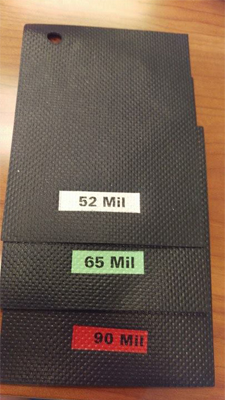
Although not directly specified in the ADA guidelines, the thickness of rubber mats can also enhance the accessibility for those with disabilities. The thickness of the rubber is important as it helps the mat lay flat, thus preventing rippling. Rippling not only leads to trip and fall injuries; it also makes it difficult for wheelchairs to maneuver over the mat.
Types of Non-Compliant Mats
Not all floor mats are the same. Rippled mats, vinyl-backed options that don’t lay flat, and traditional scatter rugs often fail to meet ADA requirements due to their potential for creating tripping hazards or unstable surfaces. Additionally, mats that aren’t properly maintained can develop curling edges or damage that transforms a once-compliant mat into an accessibility barrier. To avoid rippling, our rubber mats are always made of nitrile, and neoprene is never used.
Restaurant-style rubber mats with large circular openings may serve important safety functions in commercial kitchens, those with openings larger than 1/2 inch cannot be used on accessible routes, requiring businesses to carefully consider placement and alternative solutions.
If you’re looking for ADA-compliance, avoid the following, which don’t meet the necessary standards:
- Carpet Remnants
- Matting without bevels or backings
- Rippled, Vinyl backed mats
- Scatter rugs
How Health Mats Ensures ADA Compliance

Health Mats specializes in providing commercial facilities with floor matting solutions that meet all ADA requirements while delivering superior performance and aesthetic appeal. Our comprehensive approach to ADA compliance includes:
Expert Consultation
Our team works directly with facility managers to assess specific needs, traffic patterns, and compliance requirements. We evaluate existing matting systems and recommend solutions that enhance both accessibility and functionality. In addition to our other services, we offer free walkway safety consultations.
Compliant Product Selection
Health Mats maintains an extensive inventory of ADA-compliant mats, including options with proper beveled edges, secure attachment systems, and slip-resistant surfaces. Our products are specifically chosen to meet or exceed all relevant ADA standards while providing long-lasting durability. Plus, our service team can help you with proper placement in your facility.
Professional Installation and Maintenance
Proper installation is crucial for ADA compliance, and our professional team ensures that all mats are securely attached and properly positioned. Our regular maintenance program includes inspection for wear, damage, or curling that could compromise compliance or safety. With Health Mats, you can have your mats professionally laundered on a custom schedule, extending their life and ensuring they don’t become hazards.
Ongoing Support
ADA compliance is an ongoing responsibility, not a one-time achievement. Health Mats provides continuous support, including regular assessments, prompt replacement of worn mats, and updates on any changes to accessibility requirements.
If you’re looking for ADA-compliant commercial rental mats in PA, NJ, DE, and MD, reach out to us today!
Not sure if you want to rent of purchase? Check out the pros and cons of purchasing versus renting.